
Ecological transition
In 2024, ECAM LaSalle was awarded the renewal of the DD&RS (Sustainable Development & Social Responsibility) label for the next 4 years! 🌍💪

ECAM LaSalle is committed to engaging all campus stakeholders in a meaningful sustainable development approach
🌱 Campus :
- Reduce energy consumption.
- Improve waste management.
- Map the biodiversity found on campus.
📚 Training:
- Harmonise and strengthen sustainability-related courses across all programmes.
- Further integrate these themes into “Entrepreneurship and Innovation” pathways.
🔬 Research:
- Promote research-oriented pathways.
- Develop partnership projects, particularly in the area of energy efficiency
🙋 Responsible commitment
- Extend the “Commitment and Responsibility” module to all students.
- Create more discussion forums around major societal issues.
ECAM LaSalle has developed a DD&RSE Master Plan, with a program of thematic working groups and strategic axes to further integrate this major issue within the campus. You can consult it here.
👉 At the start of the 2025 academic year, ECAM LaSalle is launching the development of eco-delegate roles.
Want to take concrete action for sustainable development at your school? Make a real impact on campus? Make your voice and that of your fellow students heard? Join the team of eco-delegates by contacting Lydie Bouillet, Student Experience Manager.
A greener campus
For several years, ECAM LaSalle has taken an active stance on environmental issues. As an integral part of the CAMPUS 2030 plan, the concepts of energy saving and recycling are already applied to the school’s day-to-day operations.
1. The campus
Located on the Fourvière hillside, ECAM LaSalle occupies 7 hectares of green space in an urban setting. The school contributes to local biodiversity through sustainable mowing practices, eco-friendly green space management (no phytosanitary or chemical products), beehives and more.
By rehabilitating and raising the height of existing buildings (to meet teaching needs and safety and accessibility standards), the school has preserved land use, supporting sustainable housing and urban development goals.
2. Buildings
The energy performance of renovated buildings complies with RT2012 thermal regulation standards.
The most effective way to reduce our energy consumption is to continue renovating our buildings (heating, insulation, etc.).
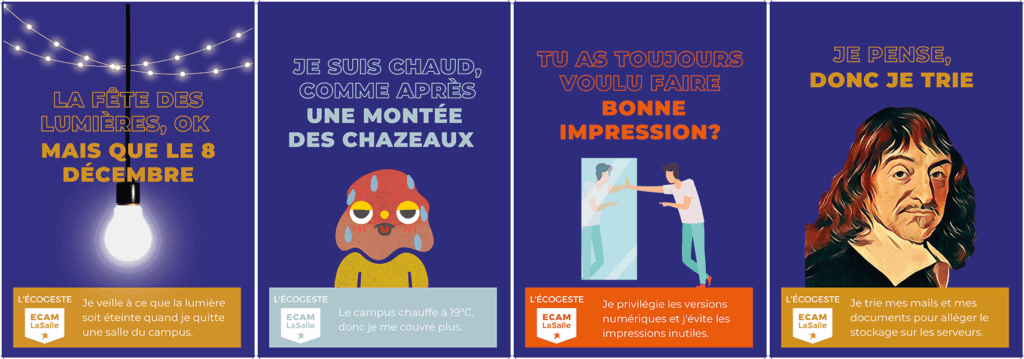
Additionally, the school is implementing an energy-savings policy (no electric heaters, maintaining a temperature of 22°C, following common sense rules such as keeping windows closed when air conditioning is installed, turning off lights, limiting the use of coffee makers and refrigerators, etc.). Smart lighting and LED upgrades are gradually being implemented.
3. Product usage
- Eco-labelled cleaning products
- FSC-certified EcoLabel paper
- Widespread use of Dyson hand dryers to reduce paper towel waste
- Reduced use of bin liners (fewer bins across campus, none in Bonnetain building classrooms, etc.)
- Chalk preferred over whiteboard markers for environmental reasons
- Duplex and black-and-white printing by default
4. Product recycling
- Furniture recycling by Valdelia
- Chemical product disposal
- Waste sorting and recycling bins
5. Travel
- 50 percent reduction in parking spaces (from 183 to 90 spaces)
- Parking app developed in-house
- Improved public transport access
- Better accessibility to the campus for pedestrians via hillside stairways and pathways
6. Food
The CROUS cafeteria is continuing its efforts to curb its impact on the environment, by using local supply chains for fruit and vegetables, sourcing meat and bread regionally, and implementing additional food waste reduction initiatives.
7. Local involvement
- Participation in Grand Site de Fourvière projects
- Closer collaboration with the CROUS cafeteria and more
A few eco-friendly habits to adopt on campus:
Sustainable development is everyone’s responsibility, and it starts with our everyday actions
- Swap disposable plastic cups for a reusable mug or coffee cup
- Use ashtrays instead of littering cigarette butts on the ground
- Sort your waste using campus recycling bins
- Limit printing on paper, print in black and white rather than colour, print on both sides and reuse your printouts as draft paper
- Switch off lights and devices before leaving
- Choose eco-friendly transport to come to campus: walk, cycle, use public transport, or carpool